Ethereum Layer 2 Explained: Rollups, Fees and Israel
Ethereum is the settlement layer for most of decentralized finance, but it has never been cheap or fast enough to serve millions of everyday users on its own. The answer the ecosystem converged on is Layer 2: a family of networks that execute transactions off the main chain and then post compressed proof of that work back to it. As of mid-2026, more than 73 active rollups collectively hold over $48 billion in total value locked, and a typical swap on the largest of them costs a few cents. This guide explains what a Layer 2 actually is, how the main designs differ, and why one of the most important pieces of the technology was invented in Israel.
Thank you for reading this post, don't forget to subscribe!What a Layer 2 Actually Does
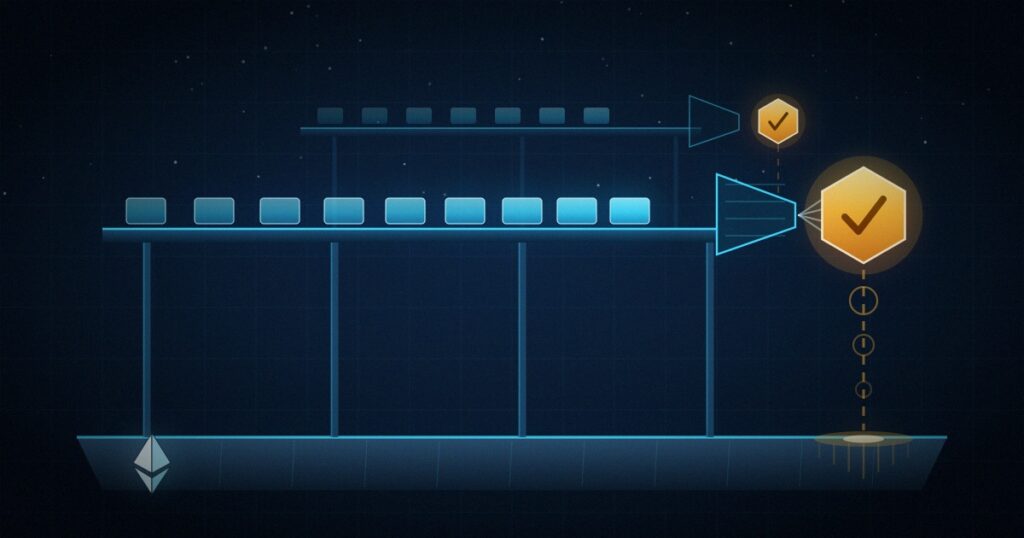
Every transaction on Ethereum mainnet — the Layer 1 — must be executed and stored by every node in the network. That redundancy is what makes the chain secure, but it also caps throughput and makes block space expensive. A Layer 2 sidesteps the bottleneck without abandoning the security. It runs its own execution environment, batches thousands of user transactions together, and periodically posts the compressed result to Ethereum. Users get cheap and fast transactions; Ethereum still acts as the final arbiter of who owns what.
The critical word is rollup. A rollup does not ask you to trust a separate validator set the way a sidechain does. It publishes enough data to Ethereum that anyone can independently reconstruct the Layer 2’s state and challenge a bad one. That inherited security is the whole point, and it is what separates a genuine rollup from a faster chain wearing a rollup label.
Optimistic vs. Zero-Knowledge Rollups
There are two ways to convince Ethereum that a batch of off-chain transactions was processed honestly. Optimistic rollups — Arbitrum One, Base, and OP Mainnet — assume the batch is valid and publish it immediately, but open a challenge window (typically seven days) in which anyone can submit a fraud proof demonstrating that the operator cheated. The design is simple and highly compatible with existing Ethereum tooling, at the cost of that long withdrawal delay when moving funds back to the main chain.
Zero-knowledge rollups take the opposite approach. Instead of assuming honesty and allowing disputes, they generate a cryptographic validity proof for every batch. Ethereum verifies the proof mathematically, so there is nothing to dispute and no week-long wait. The tradeoff has historically been engineering difficulty: producing those proofs cheaply and fast is one of the hardest problems in the field. Starknet, zkSync Era, and Linea are the best-known examples.
The Upgrade That Made Rollups Cheap
For years, the dominant cost of using a rollup was not computation but data — the fee it paid to post its batches to Ethereum. The Dencun upgrade in March 2024 changed that with EIP-4844, which introduced blobs: a dedicated, short-lived data lane priced independently of regular gas. Data-posting costs fell by roughly 80–90%, and per-transaction fees dropped below $0.10 across every major network. Blob cost today runs about $0.012 per transaction on Linea and $0.018 on Arbitrum — a gap that only matters if you are running high-frequency strategies.
The effect on end-user pricing was dramatic. A Uniswap-style swap now costs roughly one to five cents on Base and two to ten cents on Arbitrum, depending on how much calldata the trade needs and what Layer 1 gas is doing. Plain token transfers are usually under a cent. That is the difference between a chain that can host a game or a social app and one that can only host large trades.
| Network | Type | Approx. TVL | Median fee |
|---|---|---|---|
| Arbitrum One | Optimistic | ~$16.9B | ~$0.09 |
| Base | Optimistic | ~$10.7–12.8B | ~$0.02 |
| OP Mainnet | Optimistic | ~$1.7–1.9B | ~$0.09 |
| Starknet | Zero-knowledge | ~$617M | Under $0.10 |
| Linea | Zero-knowledge | ~$421M | Under $0.10 |
| zkSync Era | Zero-knowledge | ~$404M | ~$0.07 |
Liquidity Is Consolidating, Not Spreading
The headline number — 73 rollups — overstates how fragmented the landscape really is. Five networks command roughly 75% of all Layer 2 capital, and Arbitrum and Base alone account for approximately 77% of Layer 2 DeFi liquidity. Arbitrum One’s roughly $16.9 billion represents something like 40–44% of the entire market on its own, while Base leads decisively on activity with about 12.89 million daily transactions, helped enormously by Coinbase’s distribution.
For users, consolidation is mostly good news: deep liquidity means better prices and less slippage. For the long tail of rollups, it is an existential problem. Launching a chain is now trivial; attracting the capital and applications that make it useful is not. Expect more of the smaller networks to either specialize narrowly or quietly wind down.
The Israeli Connection: STARK Proofs Out of Netanya
Israel’s blockchain ecosystem has produced a great deal of infrastructure, but nothing with more reach than the work coming out of StarkWare. Founded in 2017 in Netanya by Michael Riabzev, Alessandro Chiesa, and Uri Kolodny, the company developed STARK proofs — Scalable Transparent Arguments of Knowledge — the cryptographic technique that lets thousands of transactions be bundled off-chain and verified on-chain with a single compact proof. It is, quite literally, the machinery that makes zero-knowledge rollups possible.
StarkWare has raised $287 million from investors including Sequoia Capital, Coatue, and Paradigm, at a valuation reported around $8 billion — the highest of any Web3 company in Israel, out of a local ecosystem numbering more than 170 startups. Its permissionless Layer 2, Starknet, launched on Ethereum in 2022 and lets developers deploy applications written in the Cairo language. Starknet’s roughly $617 million in TVL puts it well behind the optimistic giants in raw capital, but the underlying proof technology has spread far past any single chain: STARK-based systems are now central to the 2026 debate over Bitcoin’s own scalability and quantum resilience through proposals like OP_CAT and BitVM2.
That pattern is characteristic of Israeli blockchain companies generally. The local sector has tended to build the layer beneath the products — proving systems, custody, security tooling — rather than consumer-facing exchanges. It is less visible work, and considerably more durable. The same instinct shows up on the regulatory side, where the Capital Market Authority approved BILS, a shekel-pegged stablecoin from Tel Aviv-based Bits of Gold, in April 2026 after a two-year pilot, while the Bank of Israel continues advancing its digital shekel roadmap.
What to Watch For Before You Bridge
Layer 2s are not risk-free, and the risks are not the ones most people worry about. Nearly every major rollup still runs a centralized sequencer — a single operator that orders transactions. It generally cannot steal your funds, because the data posted to Ethereum lets you exit regardless, but it can censor or halt the chain. Decentralizing sequencers is the industry’s main outstanding homework.
The larger practical danger is bridges. Moving assets between chains has been the single most exploited surface in crypto, and the safest path is always a network’s official bridge rather than a third-party one promising instant transfers. Remember also that a token on one rollup is not automatically the same asset as its namesake on another, and that optimistic rollups impose that seven-day withdrawal window unless you pay a liquidity provider to front you the funds. Any Layer 2 you use is only as safe as the wallet holding the keys to it — a topic we covered in our guide to self-custody and wallet security.
The Bottom Line
Layer 2 stopped being a promise some time ago. It is where a growing share of Ethereum activity now happens, at fees measured in cents rather than dollars, secured by the same chain that settles the rest of the ecosystem. The open questions are no longer technical feasibility but distribution, sequencer decentralization, and whether the long tail of rollups has any reason to exist. For a sense of how the capital behind these networks has moved this year, see our analysis of what DeFi TVL really tells you, and our ongoing Ethereum coverage for the network’s broader roadmap.
For Hebrew-language coverage, visit coindex.co.il. Portuguese readers can find similar analysis at coindice.com.br.
This content is for informational purposes only and does not constitute financial advice.
Open your MEXC digital wallet and get exclusive deposit bonuses. Over 1,700 digital currencies available!
🔗 Open a Free MEXC AccountAffiliate link • Sign up in seconds