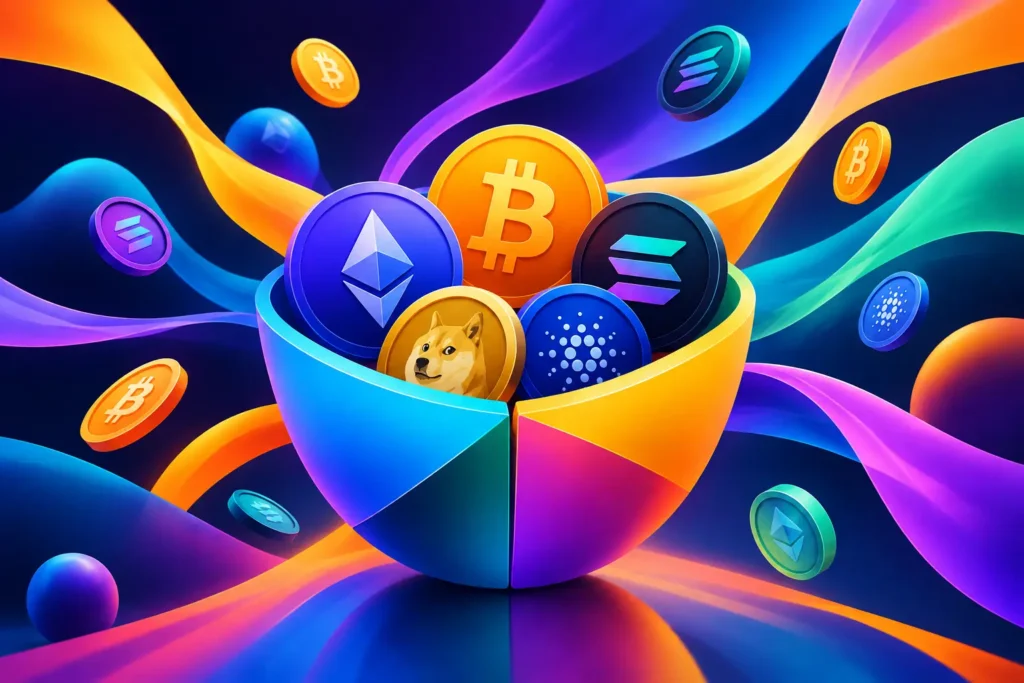
Guide to Crypto Portfolio Diversification
A portfolio that is 100% invested in one coin can move fast in either direction. That may suit a short-term conviction trade, but it is not a plan for managing risk across a volatile market. This guide to crypto portfolio diversification shows how to spread exposure with purpose, track what you own, and avoid building a collection of coins that all rise and fall for the same reason.
Thank you for reading this post, don't forget to subscribe!Crypto diversification is not about owning as many tokens as possible. It is about giving each holding a job, setting limits before emotion takes over, and using live market data to keep your allocation aligned with your actual goals.
What crypto diversification really means
Diversification means dividing capital across assets, sectors, use cases and sometimes strategies so that one failed thesis does not define your whole portfolio. Bitcoin, for example, may respond differently to market conditions than a smaller gaming token, a stablecoin, or a decentralised finance protocol. Those differences can reduce concentration risk, although they do not remove risk.
The catch is that crypto assets often become highly correlated when the market turns sharply. In a broad sell-off, many altcoins can fall harder than Bitcoin at the same time. Holding ten altcoins is therefore not automatically diversified if all ten depend on the same appetite for risk, the same blockchain ecosystem, or the same market narrative.
Think in exposures rather than token counts. Ask what could cause each position to gain or lose value. If the answer is largely identical for every holding, your portfolio may be more concentrated than it looks.
Start with your risk level and time horizon
Before choosing coins, decide what the portfolio is for. A trader monitoring prices throughout the day can take a very different approach from someone building a long-term position and checking it monthly. Neither approach is inherently better. The right structure depends on your time, risk tolerance and ability to handle a large drawdown without making a rushed decision.
A useful starting point is to separate your funds into three buckets: capital you need for normal life, capital you may need within the next year or two, and capital you can afford to put at high risk for a longer period. Crypto generally belongs in the final bucket. Never treat a volatile token allocation as money reserved for rent, bills or an emergency.
Next, set a maximum percentage for any single asset. Many investors make Bitcoin or Ethereum their core exposure and use smaller allocations for higher-risk positions. The exact percentages are personal, but the principle is consistent: your largest position should be one you understand and can hold through volatility.
Build a portfolio across different crypto roles
A practical portfolio can include assets with different functions rather than chasing every new launch. Four broad categories are worth understanding:
- Core assets: established networks such as Bitcoin and Ethereum, often used as the foundation of a crypto allocation.
- Infrastructure and platform tokens: assets linked to smart-contract networks, scaling solutions, oracle services, storage, interoperability or other blockchain infrastructure.
- Sector positions: selective exposure to areas such as decentralised finance, gaming, tokenisation, artificial intelligence-linked projects or decentralised physical infrastructure.
- Stablecoins and cash reserves: funds held back for planned entries, rebalancing or reduced market exposure. Stablecoins have their own issuer, reserve, de-pegging and platform risks, so they are not risk-free cash.
You do not need a position in every category. A smaller portfolio may be easier to understand and manage. For a beginner, a core holding plus a limited number of carefully researched satellite positions is often clearer than twenty tiny allocations that cannot be meaningfully tracked.
Avoid confusing nominal price with value. A token priced at a few pence is not automatically cheap, and a coin worth thousands of pounds is not automatically expensive. Review market capitalisation, circulating supply, token unlock schedules, liquidity, protocol use and the competitive landscape before deciding where an asset belongs in your portfolio.
Use allocation rules instead of market excitement
The market will always offer a reason to abandon your plan. A coin may double in a week, a new narrative may dominate social feeds, or a sharp drop may create pressure to sell everything. Allocation rules create a pause between the headline and your action.
Set target ranges rather than chasing perfect percentages. For example, you might decide that a core asset can sit within a defined range, while any individual speculative holding must remain below a smaller cap. If a position grows beyond its range, trim a portion. If a holding falls below its intended weight but your investment thesis remains intact, you may choose to add gradually rather than react all at once.
This is called rebalancing. It forces you to take some profit from oversized winners and reconsider weaker positions against your original reasoning. Rebalancing does not guarantee returns. It does, however, stop a single successful trade from quietly becoming an outsized risk.
Choose a schedule that fits your activity level. Long-term investors may rebalance monthly or quarterly. Active traders may monitor daily but should still avoid adjusting allocations merely because of every small price movement. Frequent changes can increase fees, tax complexity and mistakes.
Watch for hidden concentration risk
The most damaging concentration is often not obvious on a portfolio screen. You may own several tokens that appear unrelated but share the same chain, the same venture-capital backers, the same liquidity conditions, or the same dependence on a rising Bitcoin market.
Check your portfolio from several angles. How much is exposed to one blockchain? How much sits in low-liquidity assets? How much depends on a future token unlock, a protocol incentive programme, or a regulatory outcome? Are you holding multiple tokens from one sector simply because it is currently popular?
Liquidity deserves special attention. A small-cap token can show a strong percentage gain on paper, yet be difficult to sell at the displayed price when demand disappears. Wide spreads and shallow order books turn theoretical diversification into practical exit risk.
Also separate asset diversification from platform diversification. Keeping every asset on one exchange, in one wallet type or under one set of account credentials creates a different kind of concentration. Use strong passwords, two-factor authentication, sensible wallet security and a clear record of where each asset is held. Security failures can overwhelm even the best allocation plan.
Track performance with data that matters
A portfolio tracker should do more than display a total balance. Monitor allocation by asset and sector, average entry price, realised and unrealised gains, portfolio performance against Bitcoin or another chosen benchmark, and changes in market value over time.
Professional market data helps you see whether a gain came from a sound position size or from accidental overexposure. It can also reveal when multiple holdings are moving together. CoIndex-style portfolio monitoring and coin analysis can be useful here: the aim is not to stare at charts all day, but to make decisions from a clear picture of your holdings.
Keep a short investment record for every meaningful position. Write down why you bought it, what would strengthen the thesis, what would invalidate it, and the maximum allocation you will accept. When volatility hits, this note is more useful than a social-media thread written during a price spike.
Know when not to diversify
Diversification has costs. More holdings mean more research, more security considerations and more chances to own projects you do not truly understand. An over-diversified portfolio can become an expensive index of random tokens, with the weakest ideas dragging on results.
It can make sense to stay concentrated when you have a high-conviction thesis, a defined risk limit and the knowledge to monitor it. But concentration should be a deliberate decision, not the accidental result of buying the first coin you heard about or letting one winner grow unchecked.
New investors may also be better served by learning a few assets deeply before expanding. Build knowledge first, then widen exposure only when you can explain why each new holding earns a place.
A simple routine for keeping control
Review your portfolio on a fixed schedule and after major changes to a project you own. Check whether allocations still match your limits, whether the reason for holding each asset remains valid, and whether security arrangements are current. If you use an exchange with a broad coin selection, resist treating availability as a reason to buy more. Access to over 1,700 assets is useful for research and execution, not a requirement to hold dozens of positions.
Crypto rewards discipline more reliably than excitement. Set your limits, use real-time data, keep enough flexibility for changing conditions, and let every position justify the risk it adds to your portfolio.
Open your MEXC digital wallet and get exclusive deposit bonuses. Over 1,700 digital currencies available!
🔗 Open a Free MEXC AccountAffiliate link • Sign up in seconds