Decentralized Exchanges Explained: How DEXs and AMMs Work
Decentralized exchanges, or DEXs, let anyone swap one cryptocurrency for another straight from their own wallet, with no broker, no sign-up form and no company holding the funds. In 2026 they have graduated from a niche corner of crypto into core market plumbing, settling trillions of dollars a year. This guide explains what a DEX is, how an automated market maker actually sets prices, what the current numbers look like, and why the model matters, including the Israeli teams helping build it.
Thank you for reading this post, don't forget to subscribe!What Is a Decentralized Exchange?
On a traditional or “centralized” exchange (a CEX) such as Coinbase or Binance, you deposit money with the company, it holds your coins, and it matches your buy order against someone else’s sell order using an internal order book. A decentralized exchange removes the company from the middle. Trades are executed by smart contracts — self-running programs that live on a blockchain such as Ethereum — and you keep control of your coins in your own wallet right up to the instant of the swap. Because nothing is custodied by a third party, DEXs are described as non-custodial.
That design has obvious appeal after a decade of exchange hacks and collapses: if no company holds your coins, no company can lose, freeze or misappropriate them. The trade-off is that you are fully responsible for your own security. If you want a refresher on the wallet that sits at the centre of this, see our guide to hot, cold and self-custody wallets. Mistakes such as sending to the wrong address or approving a malicious contract are irreversible, so self-custody is a responsibility as much as a freedom.
How Automated Market Makers and Liquidity Pools Work
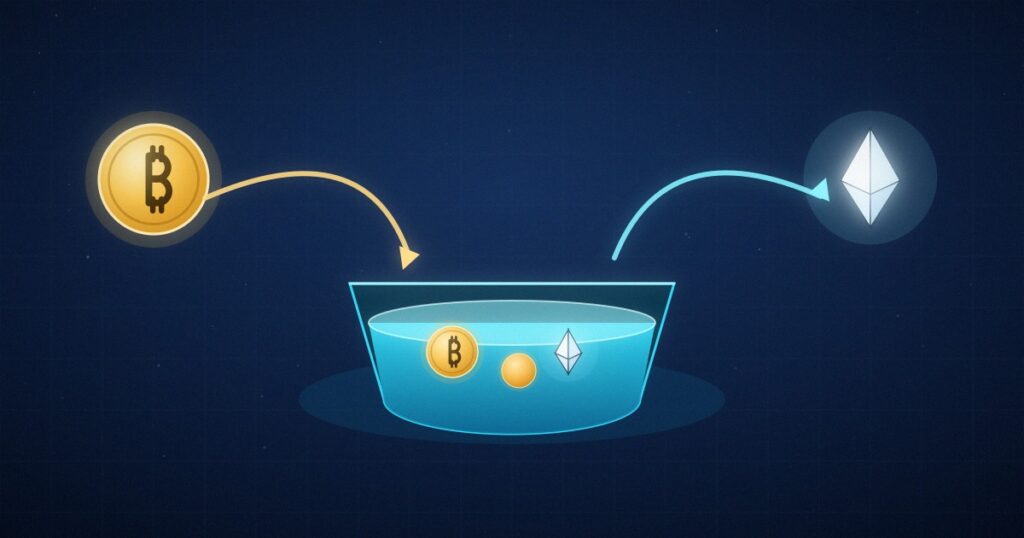
Most DEXs do not use an order book at all. Instead they rely on an automated market maker, or AMM. Rather than matching a buyer to a seller, an AMM lets you trade against a shared pot of two tokens called a liquidity pool. Anyone can deposit an equal value of both tokens into the pool and, in return, earns a slice of the trading fees that pass through it. Traders swap against that pool, and a simple mathematical formula sets the price automatically — no human market maker required.
The best-known formula is the “constant product” model, in which the amount of token A multiplied by the amount of token B must stay constant. When you buy Ethereum from a pool, you add one token and remove Ethereum; the pool now holds less Ethereum, so its price ticks up slightly for the next trader. That is why large orders “move the price” — an effect called slippage — and why a deep pool with plenty of liquidity gives better prices than a thin one. The same mechanics power the token swaps that happen on top of scaling networks; our explainer on how Layer 2 rollups work shows where much of this trading now settles to keep fees low.
Decentralized Exchanges by the Numbers in 2026
The DeFi sector cooled sharply this year. Total value locked (TVL) across decentralized-finance protocols fell roughly 39% in 2026 to about $70 billion as weaker token prices, thinner yields and a general risk-off mood pulled liquidity out of leveraged strategies. Yet trading activity tells a different story: spot DEX volume reached about $4.9 trillion in 2025, and decentralized venues now handle close to 15% of all crypto trading, up from under 8% a year earlier. Uniswap remains the largest DEX, with roughly a 36% share of decentralized volume, and its UNI governance token trades near $4.13.
| Feature | Centralized exchange (CEX) | Decentralized exchange (DEX) |
|---|---|---|
| Who holds your coins | The exchange | You, in your own wallet |
| How trades are matched | Internal order book | Liquidity pool / AMM |
| Sign-up and ID checks | Usually required | None |
| Can a trade be reversed? | Support may help | Irreversible |
| Main risk | Company failure or hack | Wallet and smart-contract risk |
The Risks You Should Understand
DEXs are powerful but unforgiving. Liquidity providers face impermanent loss, where the value of tokens deposited in a pool can drift below simply holding them if prices move a lot. Smart-contract bugs can drain a pool in seconds, so audited, battle-tested protocols matter. Anyone can list a token, which makes scam or “rug-pull” tokens common — always verify a contract address. Traders can also be front-run by bots that reorder transactions for profit, and every action costs a network fee. None of this makes DEXs unsafe by nature; it makes education essential before you connect a wallet.
The Israeli Angle: Building the Rails
Israel sits close to the heart of this technology. StarkWare, founded in Netanya in 2017, pioneered the STARK cryptographic proofs that let exchanges process huge trade volumes cheaply off-chain while inheriting Ethereum’s security; its StarkEx engine underpinned dYdX, one of the largest decentralized derivatives venues, and its public Starknet network hosts a growing DeFi ecosystem. Orbs, a Tel Aviv–based protocol, supplies decentralized infrastructure such as dLIMIT and dTWAP that add professional-grade limit and time-weighted orders to AMMs across many chains. And Fireblocks, the Tel Aviv custody unicorn, increasingly connects institutions to on-chain DeFi — a bridge between the professional world explored in our look at how institutions guard billions and the permissionless world of the DEX.
Israeli regulators are watching too. The Israel Securities Authority and the Bank of Israel have both signalled that decentralized finance is on their radar as they draft rules for digital assets, part of a broader push to give the country’s dense cluster of blockchain start-ups clearer ground to build on.
The Bottom Line
A decentralized exchange is, at its core, a piece of code that lets two strangers swap tokens through a shared pool instead of a company. It trades convenience and hand-holding for control and transparency. As the technology matures — with faster Layer 2 rails, better tooling and infrastructure from teams like StarkWare and Orbs — DEXs are becoming a permanent fixture of the crypto market rather than an experiment. For beginners, the smart path is to understand liquidity pools, slippage and wallet security first, then start small.
For Hebrew-language coverage, visit coindex.co.il. Portuguese readers can find similar analysis at coindice.com.br.
This content is for informational purposes only and does not constitute financial advice.
Open your MEXC digital wallet and get exclusive deposit bonuses. Over 1,700 digital currencies available!
🔗 Open a Free MEXC AccountAffiliate link • Sign up in seconds